Alcide Sculati: pioneer in innovation and high speed vessels

Vuoi salvare articoli per un rapido accesso?
Sali a bordo della community DN Plus.
Per te, un'area riservata con: approfondimenti esclusivi, i tuoi articoli preferiti, contenuti personalizzati e altri vantaggi speciali
Accedi RegistratiMechanical engineer and naval designer, Alcide Sculati left his mark in the industry with vessels that still stand out today




Mechanical engineer and naval designer, Alcide Sculati left his mark in the industry with vessels that still stand out today
Algide Sculari, who passed away in 2008, was an internationally renowned mechanical engineer and naval designer, recognised as a pioneer in high speeds at sea. His distinguished professional career was marked by technical innovation and the use of completely original building solutions for pleasure yachts and fast ferries.
Born in Rome, after having graduated in mechanical engineering, Sculati began his career working in the military sector in Oto Melara (a historical company knows for its production of weapons and naval and land defence systems), where he acquired the technical skills that would shape his future work as a designer.
Experience in Baglietto
From the mid-1970s to the beginning of the 1990s, Alcide Sculati worked for the Baglietto shipyard, a long-standing Ligurian brand founded in 1854, in the role of director of the technical department.
A long period (nearly twenty years) that represents the most prolific part of his career in terms of production, as he worked on nearly 100 vessels up to 45 metres, which was a record length at the time.
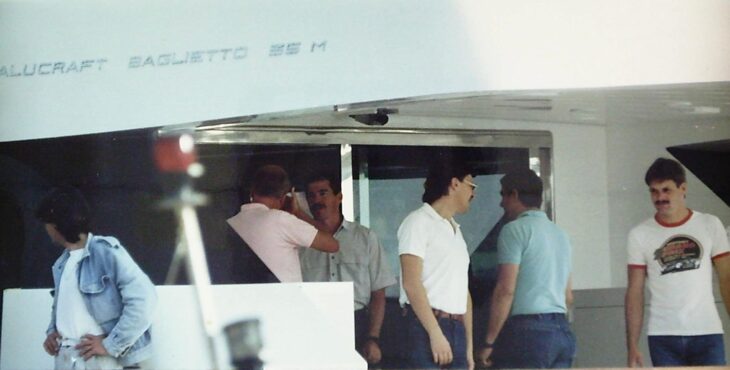
During that period, Baglietto positioned itself as one of the most innovative shipbuilders on the sector, with Sculati using lightweight building materials such as aluminium, sophisticated propulsion systems, along with carefully considered hull designs. So much so that the hulls he designed and developed for Baglietto, known as “Sculati hulls”, became a point of reference for the industry and for other designers at the time.
These were the years of iconic vessels, like the superyacht, Al Fahedi (44.82 metres, for the Dubai emir and designed by his close friend and architect Gianni Zuccon), or the 26-metre aluminium Chato (built for Baron John von Neumann) equipped with MTU engines coupled with KaMeWa water jets which allowed it to reach speeds of up to 60 knots.
Engineer Sergio Cutolo, founder of Hydro Tec and, at that time Sculati’s assistant in Baglietto, describes him as a demanding but generous teacher, remembering the long hours spent in the shipyard and his rigorous approach to design.
Rodriquez Cantieri Navali and Aquastrada ferries
After working in Baglietto, Alcide Sculati moved to Rodriguez Cantieri Navali, where he worked as technical manager until a change in ownership in 2006. During this phase of his career he worked mainly on designing fast ferries, providing a crucial contribution to the success of the Messina-based shipyard (with offices in Liguria, Campania and Brasil) during Italy’s golden age in high speed vessels.
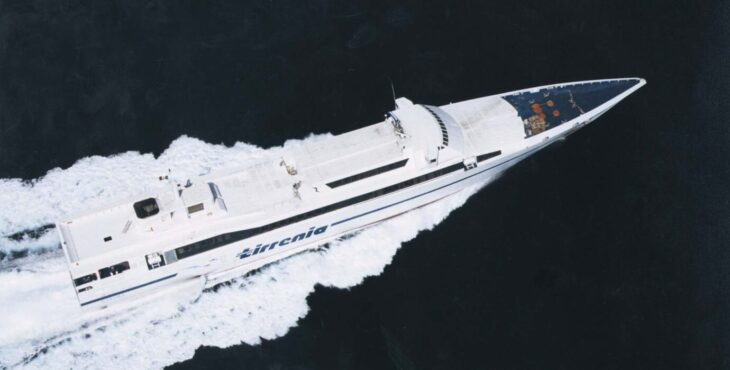
His is the series of “Aquastrada” single hull ferries, vessels that were an innovative solution for the fast transportation of passengers and vehicles, thanks to the deep V shaped hull in aluminium alloy and water jet propulsion.
The first and fastest was the Guizzo for Tirrenia, 100 metres long and reaching speeds of up to 45 knots, built in 1993 alongside her twin, Scatto. This was the first single hull in the world that could transport people and vehicles at such a fast speed: the true precursor for the fast ocean transport we have today. This result was achieved through the use of a propulsion system consisting of a 20,800 kW gas turbine connected to the central KaMeWa booster, while two diesel MTU engines powered lateral water jet packs.
The longest vessel of the series was the Federico Garcia Lorca for the Spanish company Balearia, a 115 metre ship built entirely in aluminium, built in 2001, capable of achieving 35 knots even in rough seas, thanks to the use of an extremely sophisticated anti-rolling system comprised of stabilising fins, intruder and T-Foil design and built completely “in house” with engineer Alessandro Cappiello, founder of CMC Marine. These are designs and specifications we are used to today, but 25 years ago, they were truly innovative.
Designing innovation
All of the solutions designed by Alcide Sculati stand out for their innovation. He was one of the first in the world to use lightweight alloy and water jets on large vessels, pre-empting technology and materials that were to become standard in the boating industry. Choosing aluminium significantly reduced the overall weight of the vessels, improving performance in terms of speed and consumption, and his deep V-shaped hulls provided stability even at high speeds, while the water jet propulsion, combined with diesel engines and gas turbines in larger ferries, allowed them to achieve exceptional performance.
Curated designs that also included high level safety parameters: the designer often said that a fast ferry like Aquastrada could implement an emergency stop at maximum speed in a distance of just three ship lengths. In 2004, the Unione Nazionale Cantieri e Affini (UCINA), now Confindustria Nautica, honoured Sculari with an award for “Boating Pioneer” in the Manager category, declaring him to be a “designer of ships and pleasure yachts and a professional of undisputed technical value.”
Alcide Sculati’s undisputed heritage
Alcide Sculati’s designs are still significant in the Italian boating industry today. His hulls are still studied and many of his technical solutions are still applied, in particular his use of aluminium and water jet propulsion systems have become fundamental elements in the construction of fast vessels. His skill in combining high performance and reliability set the foundations for the development of fast ferries and high performance yachts.
Topics: Daily Nautica